The hidden gap in early cardiac risk screening
NeuroPulse is a proposed early-screening concept for cardiac autonomic dysfunction, combining three reflex-based measurements in wearable headgear and a companion app.
Developed as an interdisciplinary team during INCUBATE, a hackathon hosted by IIT Bombay and JIPMER. The team brought together two MBBS students, one ECE student and a product-design perspective.
The concept explores how autonomic dysfunction may remain unnoticed and how a preliminary screening workflow might become more accessible in primary and community healthcare settings.
Project framing from the concept: “Catch what ECG can't”, an early-screening concept focused on nerve–heart response signals.
The concept has not been clinically validated. Performance and prevalence claims would need independent evidence before public use.
Could screening look beyond a single signal?
The team explored how early autonomic changes might go unnoticed in people with diabetes, and whether a guided, non-invasive screening concept could encourage timely clinical follow-up.
The design question was how to bring multiple physiological response signals into one understandable experience, without presenting a concept device as a diagnosis or a replacement for established clinical assessment.
Design direction: Explore a combined screening experience that is portable, guided and designed around a healthcare professional's workflow.
A potential gap, not a patient story.
We focused on a general screening challenge: a person may feel well and still have early changes that are not captured by the checks routinely available in every setting.
Routine checks
- Common cardiovascular checks
- Periodic follow-up
- Clinical assessment when indicated
What could be missed?
- Early autonomic response changes
- Signals that need specialised assessment
- Barriers to repeatable screening
Support the next step
- Make a guided test easier to administer
- Bring multiple signals together
- Support referral and clinical review
The concept would require clinical validation and professional oversight before any screening or referral use.
Tri-reflex fusion, the core concept
The central design idea is to combine three physiological response channels in one wearable screening setup.
Pupillary light reflex
Uses a controlled light stimulus and camera-based observation of pupil response latency and recovery patterns. This channel is intended to reflect parasympathetic response.
Auditory startle response
Uses an auditory stimulus and records response timing and intensity. This channel is intended to reflect sympathetic response.
Heart-rate variability
Uses pulse/PPG signals to analyse beat-to-beat rhythm patterns and trends, explored as a cardiac autonomic marker.
From rough ideas to a wearable form
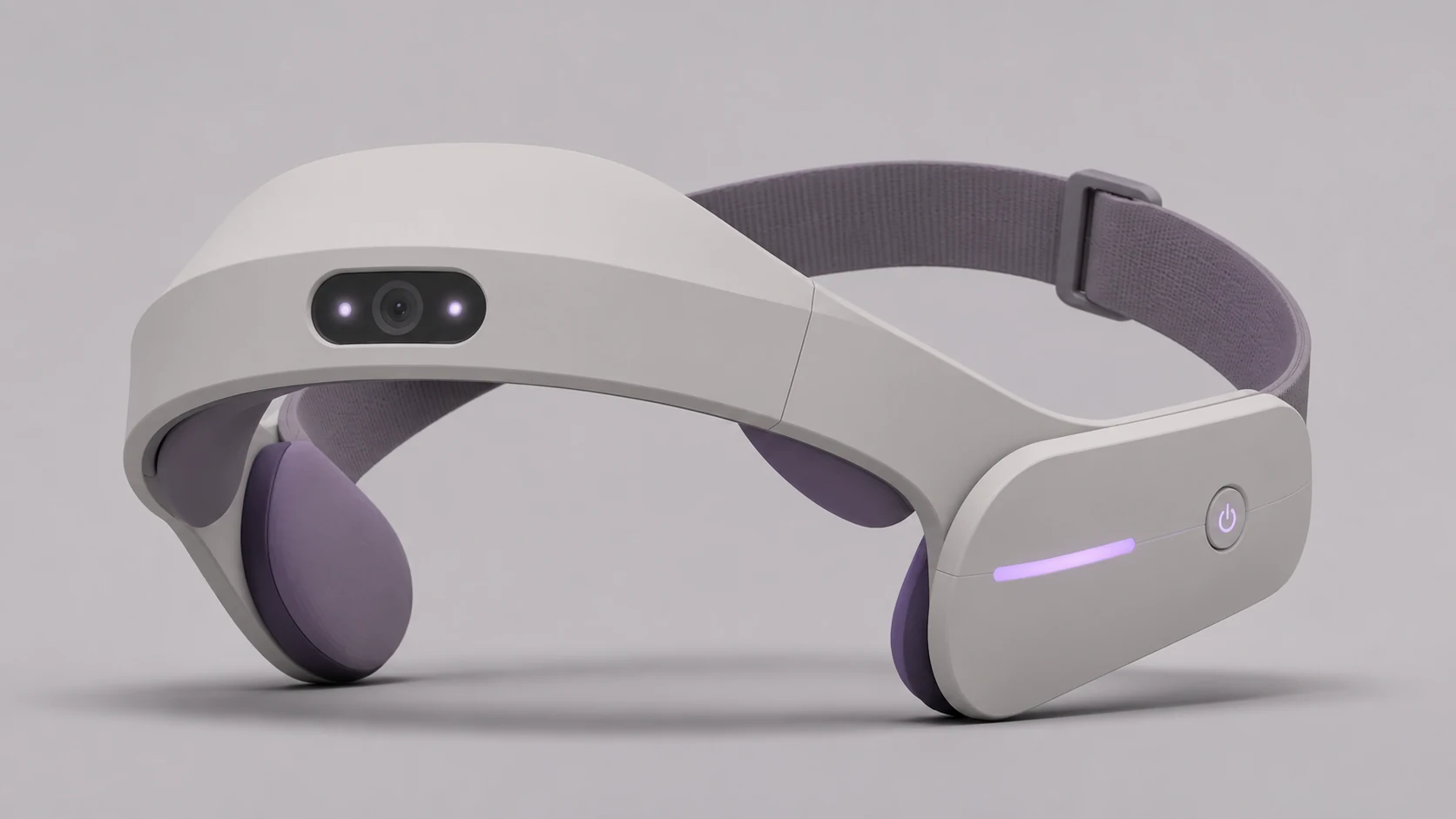
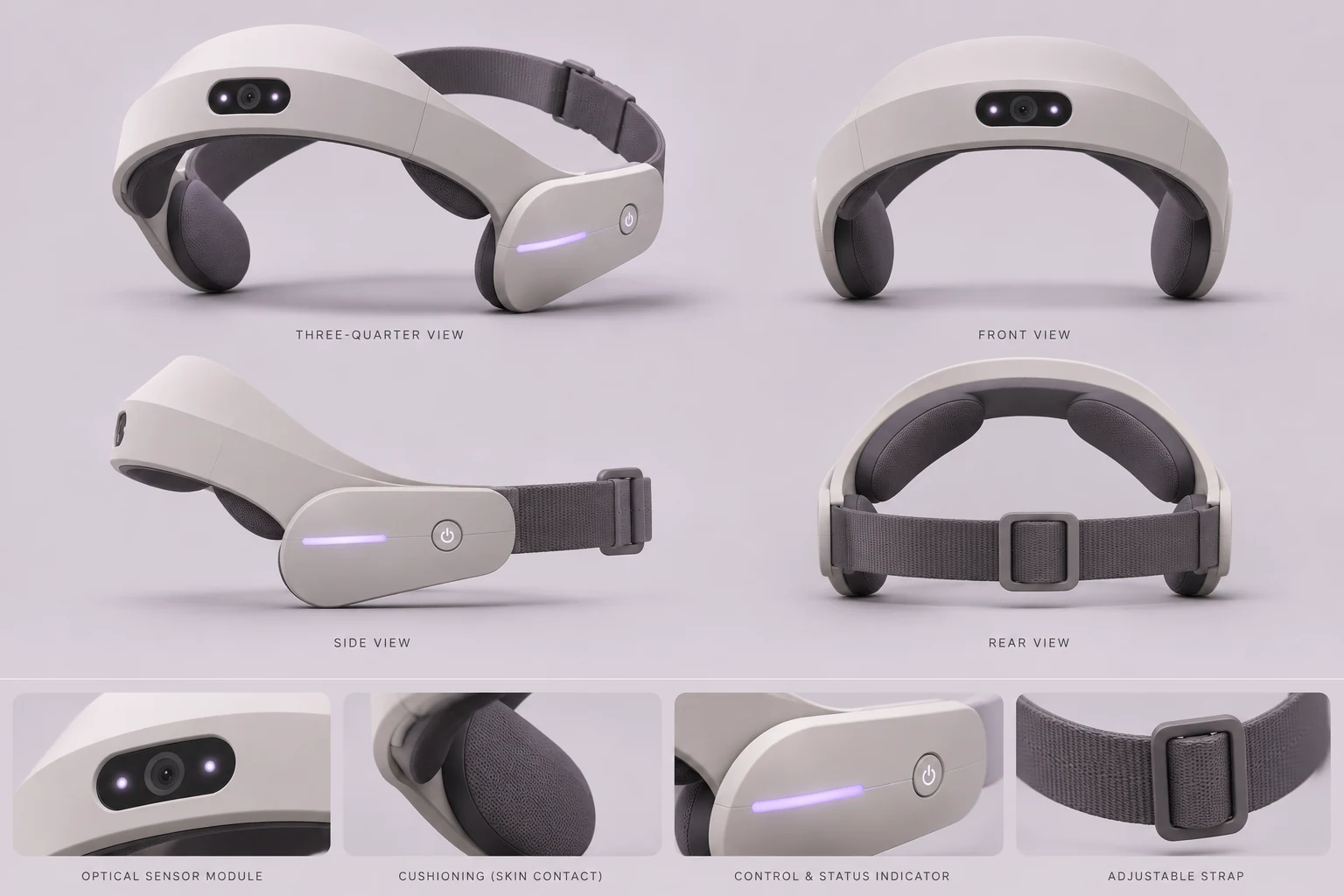
I explored the headband as a wearable arrangement for the proposed sensing components, moving from quick form sketches to refined proportions and rendered views.
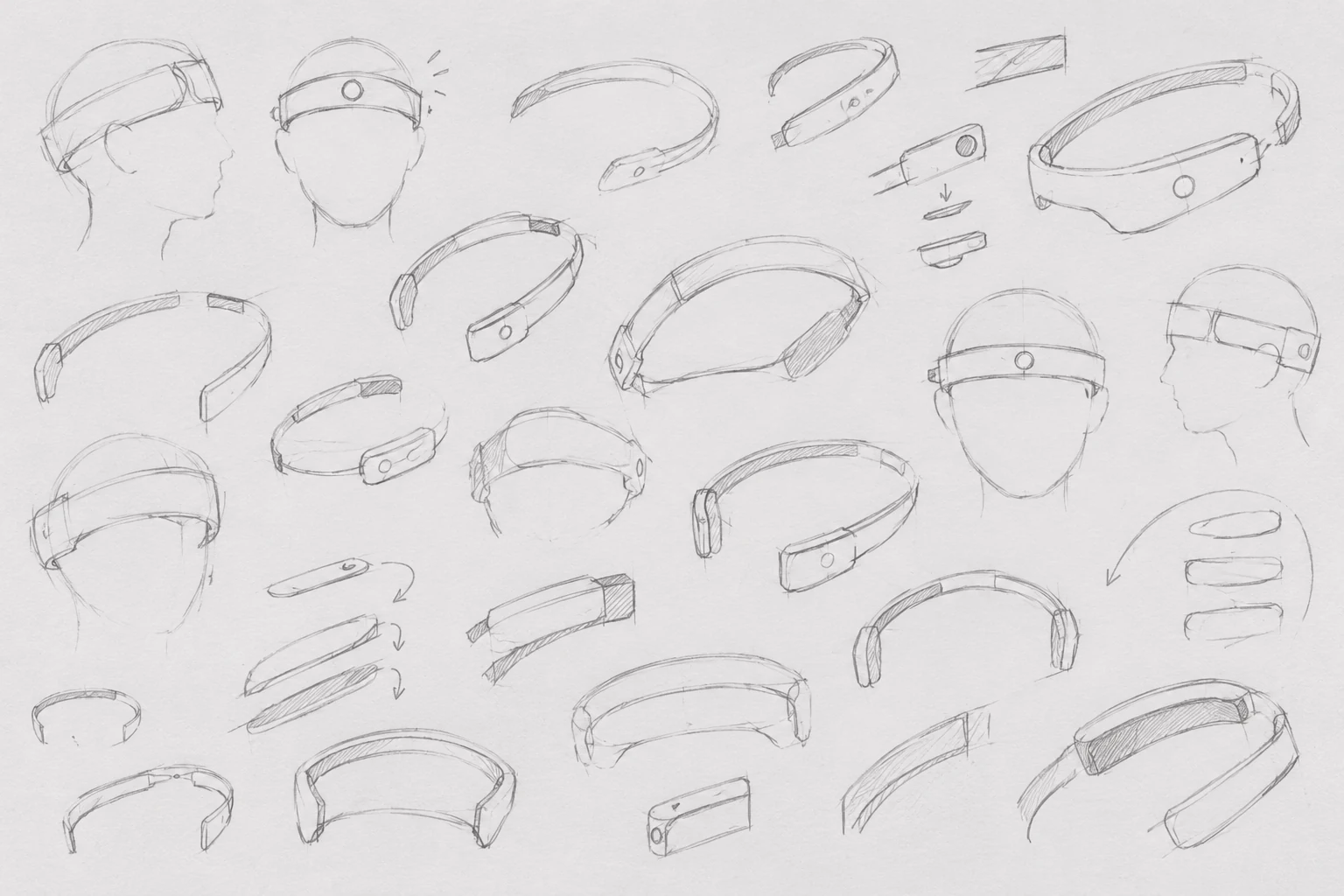
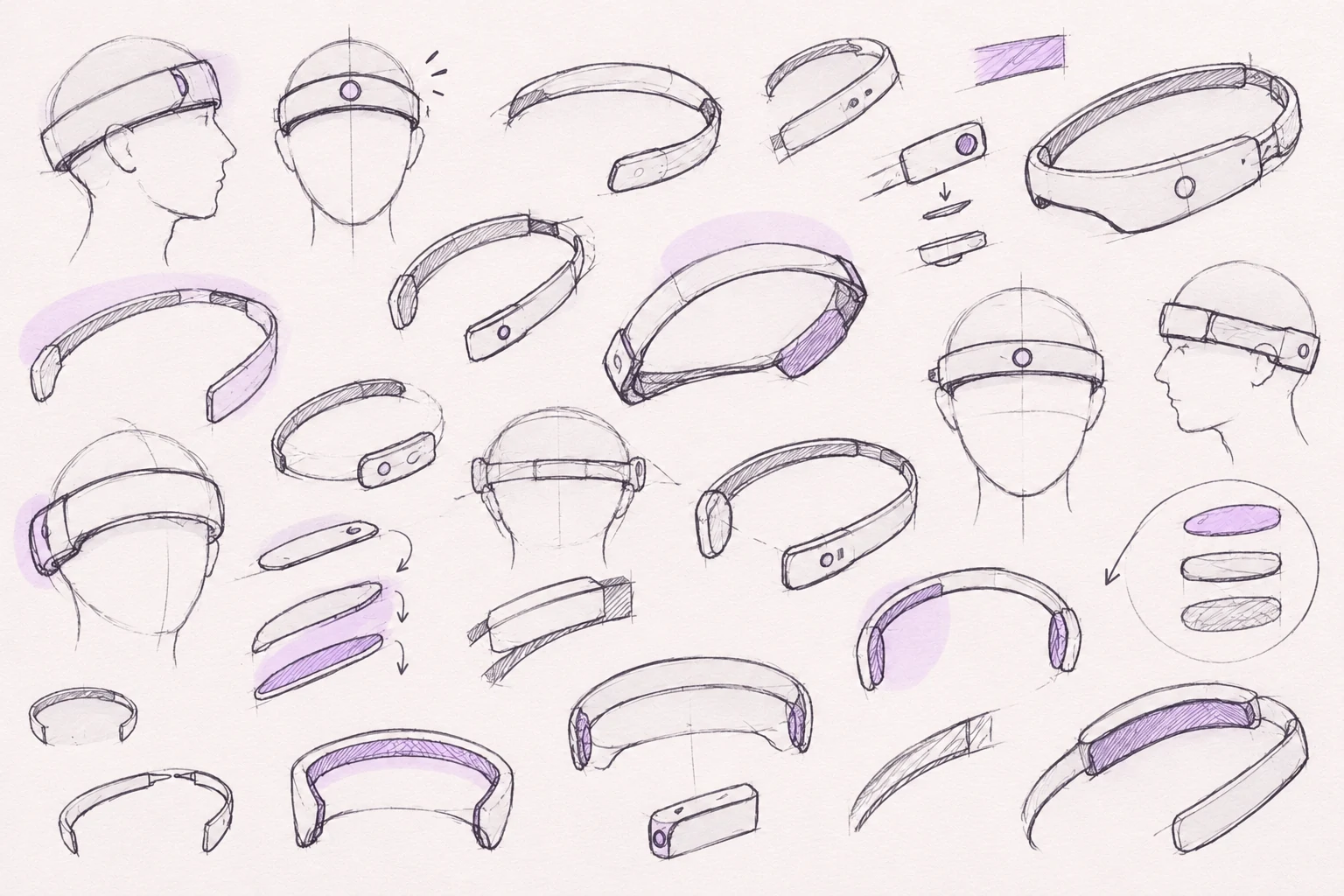
How the proposed screening works
The proposed experience uses a guided protocol followed by on-device processing and a colour-coded risk band.
Guided protocol
- Flash test to observe pupil latency.
- Sound prompt to capture auditory reflex response.
- Guided breathing while capturing PPG/HRV.
Processing and output
- Real-time FFT and signal analysis.
- On-device processing and threshold-based interpretation are proposed.
- A green / yellow / red risk-band interface is proposed.
Wearable hardware & industrial design
The concept is presented as an ergonomic headgear rather than a conventional clinical cart or multi-device setup.
Hardware snapshot
- PPG sensor, HRV / pulse waveform capture.
- Camera + LED array, pupillary light reflex capture.
- Bone-conduction microphone / speaker, auditory stimulus and response.
- OLED display, on-device status / feedback.
- Adjustable headband, fit and sensor positioning.
The concept also explores battery power, offline operation, ergonomic design and a short guided test.
Where the concept is intended to fit
NeuroPulse was envisioned for low-resource screening environments and community-level healthcare programmes.
Potential use settings
- Primary Health Centres and Community Health Centres
- Diabetes and post-COVID follow-ups
- Geriatric, paediatric and school health screenings
- Rural NCD screening camps
Potential public-health alignment
- National Programme for Prevention and Control of Cardiovascular Diseases
- Ayushman Bharat Health and Wellness Centres
- Community health programmes
- School Health & Wellness Programme
These are proposed use cases and programme alignments, not confirmed partnerships, approvals or deployments.
What must be validated before deployment
NeuroPulse is an early tri-reflex fusion concept. Any performance claims would need evidence before they could be used as product specifications.
Clinical validity
Compare the proposed signals and risk bands against recognised autonomic function tests and clinician assessment.
Measurement reliability
Test repeatability across users, age groups, skin tones, movement and environmental conditions.
Algorithm transparency
Define signal-processing methods, thresholds, uncertainty and how false positives / negatives are handled.
Safety and usability
Validate light and sound stimulus parameters, fit, hygiene, accessibility and use by trained staff.
Performance claims
Establish sensitivity and accuracy through appropriately designed clinical studies.
Cost and scale
Confirm bill of materials, manufacturing cost, maintenance, calibration and field support before quoting affordability.
Important: No accuracy, sensitivity or early-detection performance is claimed here because those outcomes have not been clinically validated.
What the project proposes
NeuroPulse brings together a wearable form factor, three reflex-based sensing concepts and a guided screening workflow in a single early-stage healthcare innovation proposal.
- A tri-reflex concept spanning pupillary, auditory and cardiovascular response.
- An ergonomic headgear concept with camera, LED, PPG, audio and display components.
- A guided workflow with proposed on-device signal processing and risk-band output.
- A deployment vision for PHCs, CHCs and community screening programmes.
The next step is not simply scaling the concept: it is engineering the prototype, validating each measurement and testing whether the combined screening pathway is clinically meaningful and safe.
Reflection: A compelling medical-device concept must be as rigorous about what it cannot yet prove as it is ambitious about what it hopes to enable.